Scrum Is Dead. Long Live Agile.
Why Continuous Product Flow Works Better in Hyper-Innovative Product Development
In AI-driven products, traditional roadmaps fail with surprising reliability.
Not because teams are bad at planning—but because knowledge, models, and customer needs evolve faster than milestones can be fixed.
At Vionlabs, this reality fundamentally shaped how we think about product development. We don’t believe this is a Vionlabs-specific method or a branded framework. We believe it is a necessary response to how modern, highly innovative AI products actually behave.
This article explains why we believe continuous product flow is the only viable approach when innovation speed, uncertainty, and system complexity dominate.
Why Roadmaps Break in AI Products
Roadmaps work when:
- requirements are stable,
- solutions can be defined upfront,
- feedback arrives late and infrequently.
AI products meet none of these conditions.
Models change as data changes. Quality only reveals itself in production. Customers often discover their actual needs after using the product. Yet roadmaps force teams into fixed timelines and feature promises made before learning happens.
The result is predictable:
- features ship but aren’t used,
- APIs evolve quietly under the surface,
- innovation introduces instability,
- trust erodes—internally and externally.
More planning doesn’t fix this.
It only postpones the moment of truth.
The Core Mistake: Confusing Planning with Progress
In complex systems, planning is not proof of progress—it is a hypothesis. The earlier it is frozen, the higher the likelihood it will be wrong.
This is especially true for AI-driven products:
What we believe to be true today is often only partially true tomorrow.
The mistake many organizations make is treating early assumptions as commitments. Continuous product flow inverts that logic: learning comes first, structure supports learning, and commitments follow evidence—not the other way around.
Continuous Product Flow: What We Actually Mean
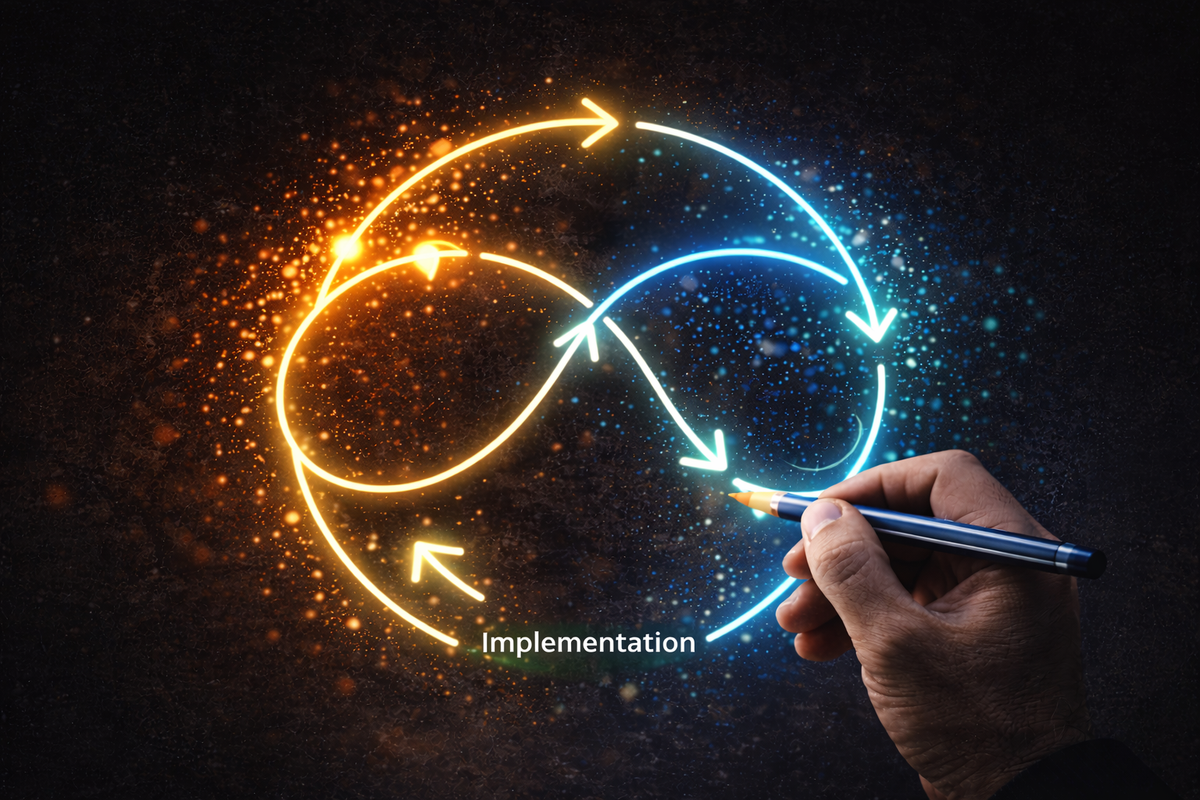
We view product development not as a sequence of phases, but as a permanent loop. A system designed to absorb change without destabilizing itself.
That loop consists of four constant elements:
- Real customer problems
Not feature requests, but friction observed in real usage. - Product and model hypotheses
Explicit assumptions about what might improve outcomes. - Implementation in small, controlled steps
Technically clean, versioned, observable, and reversible. - Feedback from real-world usage
Measurable, visible, and prioritizing.
This loop never stops. There is no “done”—only a stable, controlled state from which learning continues.
Why This Matters to Customers
From the outside, product development can feel abstract. Continuous product flow makes it tangible:
- Stability without stagnation
Innovation happens without breaking existing systems. - Predictability despite change
Customers decide when to adopt new capabilities—not the vendor. - Transparency over surprises
Evolution is visible, intentional, and explainable. - Learning instead of standstill
Feedback flows directly back into the product.
This is not an internal efficiency trick.
It is a trust model.
The Discomfort Is the Point
This way of working is not always comfortable:
- it requires architectural discipline,
- it forces teams to live with uncertainty,
- it exposes incorrect assumptions early.
That discomfort is intentional.
In complex AI systems, pretending uncertainty doesn’t exist is the real risk.
Why This Is Essential for AI Products
AI systems do not evolve linearly:
- models age,
- data distributions shift,
- quality is context-dependent,
- costs don’t scale proportionally.
Continuous product flow accepts this reality and builds systems that can learn without destabilizing themselves. Progress doesn’t come from big leaps, but from continuous, integrated improvement.
Conclusion: This Is Not a Process—It’s a Belief
This approach doesn’t replace roadmaps with chaos.
It replaces false certainty with learning capability.
For us, that means:
- product development is a flow, not a project,
- stability comes from control, not from freezing change,
- trust comes from transparency, not from promises.
In a world where AI products are becoming ever more complex, this is not optional.
It’s how we believe modern product development must work.